
Exposed Aggregate Driveways Gold Coast
Tired of plain grey concrete that looks cheap, stains easily, and becomes dangerously slippery when wet? Our QBCC-licensed team pours engineered exposed aggregate driveways, pool surrounds, and patio slabs using local Gold Coast pebbles, high-strength N32 concrete, and commercial UV sealers compliant with AS 3600 & AS 2870.
Request a Free Quote
Fill out the form below and our local team will contact you for a site measurement shortly.
What is Exposed Aggregate Concrete & How Does It Work?
Exposed aggregate concrete is a premium decorative concreting technique where the top layer of cement matrix is washed away before curing, exposing natural stones, quartz pebbles, or crushed granite embedded beneath. Unlike plain broomed concrete, exposed aggregate provides superior structural grip and timeless architectural beauty.
Exposed Aggregate vs. Plain Concrete
Plain concrete is inexpensive but prone to visible tire marks, oil absorption, and a dull utilitarian look. Exposed aggregate hides dirt, provides exceptional wet-weather foot traction, and increases property resale value across Gold Coast residential estates.
Exposed Aggregate vs. Pavers
Paving stones shift over time, allowing weeds to sprout between joints. Exposed aggregate is a solid, continuous reinforced slab that eliminates weeds, ant mounds, and unlevel tripping hazards permanently.
Climate & Ground Factors Affecting Exposed Aggregate in SEQ
Concreting on the Gold Coast requires deep understanding of local environmental conditions:
- • Subtropical Humidity & Wash Timing: High humidity alters concrete set times. Our crews monitor surface hydration closely so the top cement paste is washed at the exact micro-window for uniform aggregate exposure.
- • Salt Air Exposure (Hope Island & Sanctuary Cove): Coastal salt spray can erode poor quality concrete. We pour high-density N32 grade concrete with marine-grade UV acrylic sealers to prevent salt pitting.
- • Reactive Clay Soils (Pimpama & Coomera): Expansion in clay soils causes plain slabs to crack. We install 50mm compacted roadbase and SL82 steel reinforcement mesh on bar chairs per AS 2870.
Our Exposed Aggregate Pouring Process
Excavation & Base Compaction
We excavate topsoil to 150mm depth, compact the subgrade using heavy mechanical plate compactors, and lay a solid 50mm roadbase sub-base to prevent slab movement.
SL82 Mesh & Formwork Setup
We set straight timber edge formwork, lay plastic moisture underlay, and elevate heavy SL82 steel reinforcement mesh on 50mm plastic bar chairs per AS 2870.
N32 Concrete Pour & Surface Retarder
We pour high-density N32 concrete premixed with natural QLD river pebbles, screed level, hand float, and apply a specialized chemical surface retarder to control curing.
Pressure Wash & UV Acrylic Sealing
At the exact hydration window, we high-pressure wash away top cement paste to reveal the aggregate, saw-cut control joints, and seal with 2 coats of UV solvent acrylic sealer.
Why Cheap Exposed Aggregate Jobs Fail (And How We Fix It)
We are frequently called to repair or replace botched exposed aggregate driveways poured by unlicensed operators. Here are the 3 most common failure modes:
1. Patchy Aggregate Exposure
Washing off the top paste too early dislodges pebbles creating deep hollows; washing off too late leaves ugly cement film over the stones. Our crew uses precision retarder spray and timed wash-off for 100% consistent stone exposure.
2. Steel Mesh Sinking to Bottom
Unlicensed concreters lay steel mesh directly on the dirt instead of elevating it on plastic bar chairs. The steel rusts from ground moisture and the slab snaps under vehicle weight. We elevate all SL82 mesh on 50mm chairs.
3. Skipping UV Solvent Sealer
Failing to apply 2 coats of UV-stable solvent acrylic sealer allows engine oil stains and green algae to soak into porous pebbles. We apply commercial-grade clear acrylic sealers to lock in color and shine.
Exposed Aggregate Driveways Across Northern Gold Coast Suburbs
We pour exposed aggregate driveways, pool surrounds, and patio slabs across the northern Gold Coast corridor. Below is a breakdown of the most common project types and site conditions we encounter in each area.
Exposed Aggregate — Sanctuary Cove
Sanctuary Cove is a gated canal community where driveways and pool surrounds are visible from the water and neighbouring properties. Exposed aggregate is a natural fit — the stone finish complements waterfront landscaping, and our N32 marine-grade concrete with UV acrylic sealer resists the salt-air environment. We carry pebble samples to match existing estate colour schemes.
Exposed Aggregate — Kingsholme
Kingsholme is a semi-rural suburb in postcode 4208 with predominantly acreage and large-block residential properties. Driveways here tend to be longer than standard suburban runs, and the ground is a mix of rocky subsoil and compacted clay. We excavate to solid subgrade, lay SL82 mesh, and pour N32 exposed aggregate suited to both the slope and the rural aesthetic.
Exposed Aggregate — Willow Vale
Willow Vale sits on the northern fringe of the Gold Coast hinterland, where properties feature elevated, sloped sites and long driveway approaches. Exposed aggregate provides natural grip on inclined surfaces, making it a practical and attractive choice for properties with steeper access. We adjust our pour schedule and retarder application to account for the cooler temperatures at higher elevations.
Exposed Aggregate — Pimpama
Pimpama (4209) is one of the fastest-growing residential corridors in Queensland, with estates such as Gainsborough Greens and Providence built on reactive clay-loam subsoils. We install 50mm compacted roadbase and SL82 reinforcement as standard on all Pimpama pours to prevent slab cracking from seasonal soil movement. A popular finish here is salt-and-pepper QLD river pebble.
Exposed Aggregate — Coomera & Upper Coomera
Coomera and Upper Coomera include a mix of new estate homes and established properties near Westfield Coomera. We regularly pour exposed aggregate driveways, side-access boat slabs, and patio extensions throughout the area. Coomera Waters canal-front properties often require salt-resistant sealer upgrades — we carry marine-grade UV acrylic as standard for these sites.
Exposed Aggregate — Hope Island
Hope Island (4212) properties sit in a low-lying, high-humidity coastal environment. Canal-front homes and golf course estates demand premium finishes that perform in salt air and wet conditions. We specify N32 high-density concrete with two coats of commercial UV acrylic sealer on all Hope Island pours. Non-slip aggregate surrounds around pools and jetties are a frequent request.
Exposed Aggregate — Oxenford
Oxenford (4210) is a well-established suburb with a mix of older properties needing driveway replacement and newer homes in adjacent developments. Exposed aggregate is often chosen here to replace ageing plain concrete slabs that have cracked or stained over time. We handle full excavation and removal of the existing slab as part of the replacement scope.
Exposed Aggregate — Pacific Pines
Pacific Pines is a hilly suburb in northern Gold Coast where many properties have split-level driveways or sloped approaches. The gradient on some blocks makes exposed aggregate a practical safety choice — the textured pebble surface provides reliable wet-weather grip on slopes. We assess each site's gradient during the free quote to confirm appropriate slab thickness and reinforcement.
Exposed Aggregate — Stapylton & Yatala
Stapylton and Yatala (4207) include light industrial blocks, lifestyle properties, and residential homes on larger allotments. Exposed aggregate driveways and hardstand areas are common here, particularly for properties needing heavy-duty slabs that can handle occasional commercial vehicle access. We specify N32 concrete and SL82 mesh as a minimum for all hardstand and driveway pours in this area.
Serving all suburbs within the northern Gold Coast and southern Brisbane corridor. Not sure if we cover your area? Call 0411 914 157 or submit a quote request with your suburb and we will confirm.
Recent Exposed Aggregate Concreting Finishes
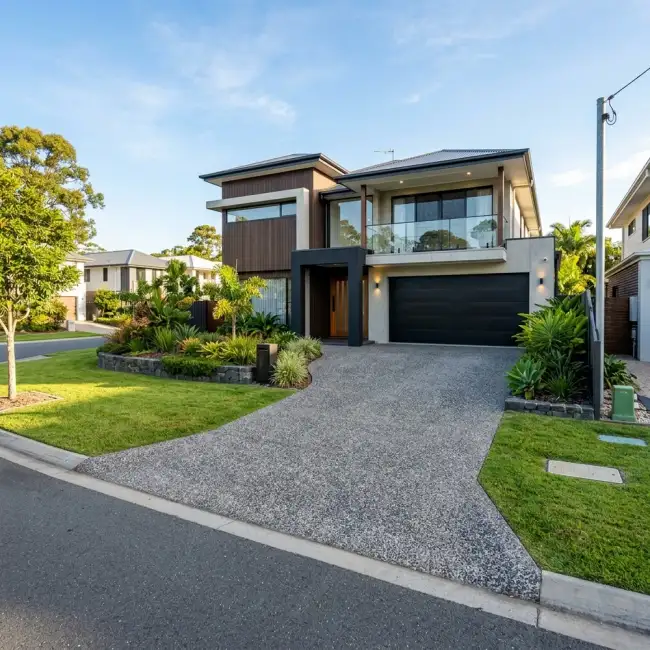 Exposed Aggregate
Premium Exposed Aggregate Pour
Salt-and-pepper QLD river pebble aggregate drive pour with commercial clear acrylic sealer.
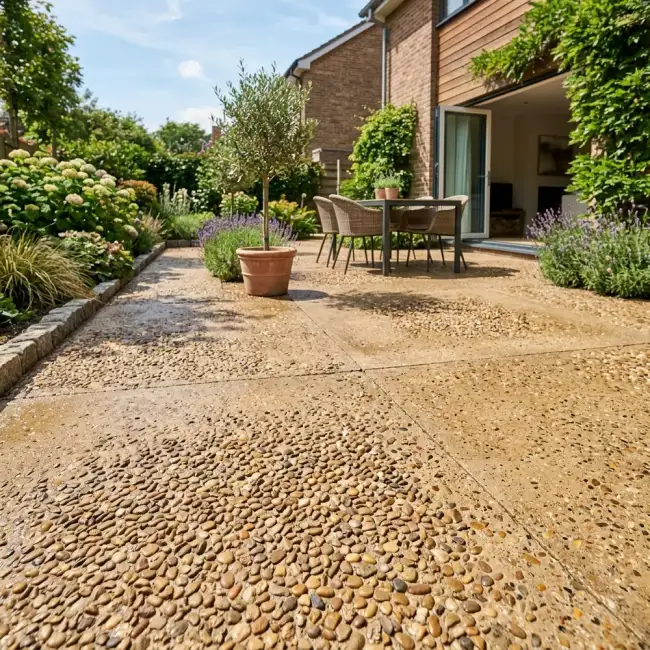 Coloured Aggregate
Charcoal Base Coloured Aggregate
Dark oxide concrete matrix with white quartz stones poured for a modern Hope Island residence.
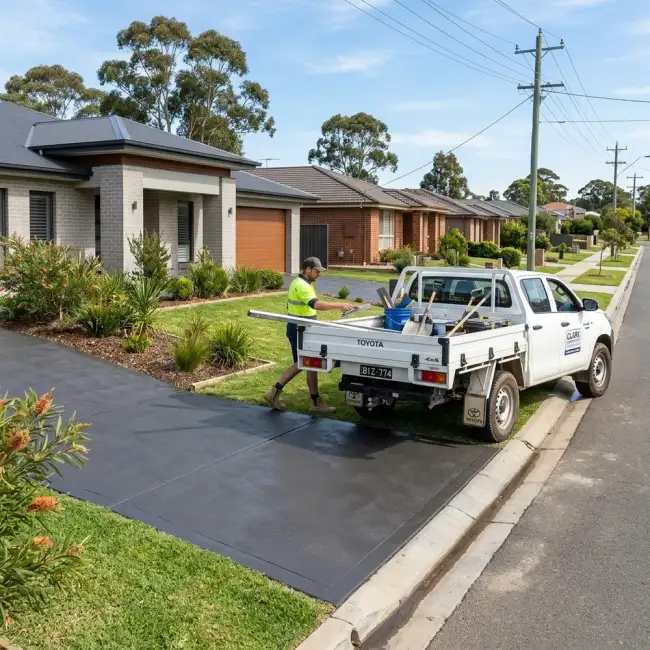 On-Site Team
Licensed QBCC Crew On-Site
Fully equipped mobile concreting rig serving Ormeau, Coomera, Hope Island, and Northern Gold Coast.
What Property Owners Say
"Had an exposed aggregate driveway poured for our canal home in Hope Island. Non-slip finish around our pool path and the pebble blend matches our landscaping perfectly!"
Sarah M.
Homeowner, Hope Island"Poured a 110m² exposed aggregate driveway in Ormeau Ridge. Solid N32 mix, SL82 steel mesh on chairs, and high quality UV sealer. Highly recommend!"
Mark R.
Property Owner, OrmeauService Suburbs Across Northern Gold Coast
Frequently Asked Questions — Exposed Aggregate
Q: How much does an exposed aggregate driveway cost on the Gold Coast?
A: Exposed aggregate costs depend on driveway size, chosen pebble aggregate blend, excavation depth, site access, and sealer grade. Because every site is unique, we do not provide fixed online estimates. Call us on 0411 914 157 or fill out our quick quote form for a free, accurate, no-obligation on-site quote.
Q: Is exposed aggregate concrete slippery around swimming pools?
A: No. Unlike smooth troweled concrete, exposed aggregate features natural stone textures that provide superior slip resistance, making it ideal for Gold Coast pool surrounds and wet entertaining areas.
Q: How do you prevent exposed aggregate driveways from cracking?
A: We prevent cracking by compacting a 50mm roadbase sub-base, placing SL82 steel mesh on bar chairs, pouring N32 concrete, and saw-cutting expansion control joints every 3 to 4 metres.
Q: How long before I can drive on a new exposed aggregate driveway?
A: Foot traffic is permitted after 24 to 48 hours. We recommend keeping passenger vehicles off the slab for 7 days, and heavy caravans or trucks off for 28 days.
Q: How often should an exposed aggregate driveway be re-sealed?
A: We recommend re-sealing exposed aggregate driveways every 2 to 3 years with commercial UV solvent acrylic sealer to preserve stone color vibrancy and prevent oil absorption.
Our Partners
and construction commission